Check the mode.
Paper mode uses simulated money. Real trading requires your explicit GO LIVE confirmation and the app's account and policy checks.
Go deeper / 0.4.0-beta
Your rules. Your trades. Automated. Here's what that looks like inside Ballast: the screens you use, the checks before an order and the connections that make it work.
The actual interface
These are screenshots of the released beta interface, rendered with isolated sample data. They are cropped to show the workflow. No live accounts, real trades or performance results are shown.
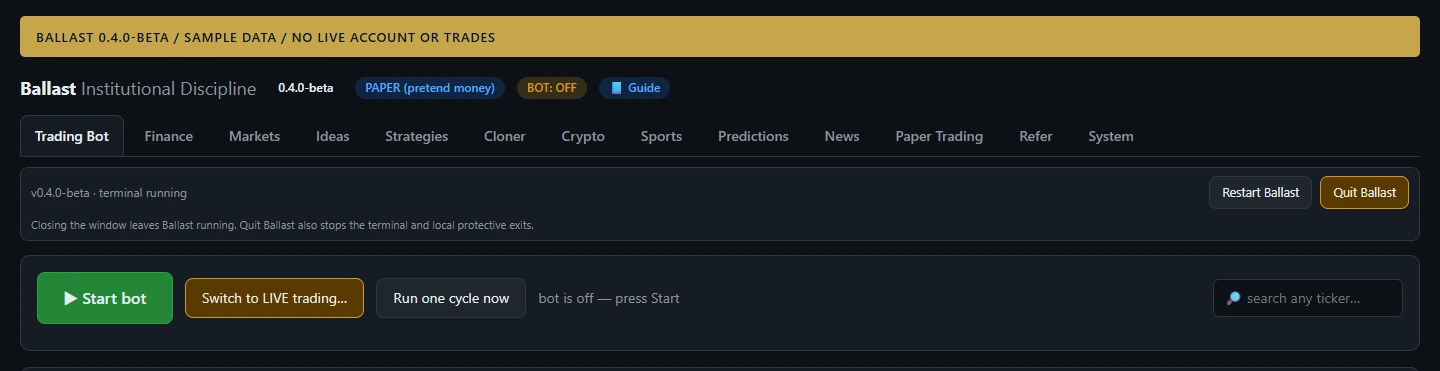
Paper mode uses simulated money. Real trading requires your explicit GO LIVE confirmation and the app's account and policy checks.
Start/stop trading and quit/restart the application are different actions. Closing the browser window alone can leave Ballast running.
Review decisions and broker order status. A submitted order is not the same as a completed trade.
The decision loop
Ballast uses scheduled checks and the settings you choose. A price condition is one input: mode, account readiness, spending limits and other controls can still prevent an order. This is a simplified view; entry and exit paths have different rules.

Review the watchlist, trade size, available funds, exposure limits and any entry pause or cooldown. A missing input or failed check can skip a buy.
The bot records its order request before sending it. Queued, submitted or partially filled orders must not be treated as complete fills.
Ballast can hold further orders for review, including exits. Reconcile with the broker's execution record instead of assuming an order failed and retrying it.
Automated checks need the app, data and broker access to be available. Stops cannot guarantee a fill or price. Read the trading logic or operating guide.
Research is a separate step
The Strategies section organizes research into desks. Review the thesis, risks, source material and age of the analysis. A research score is not a probability of profit or permission to trade.
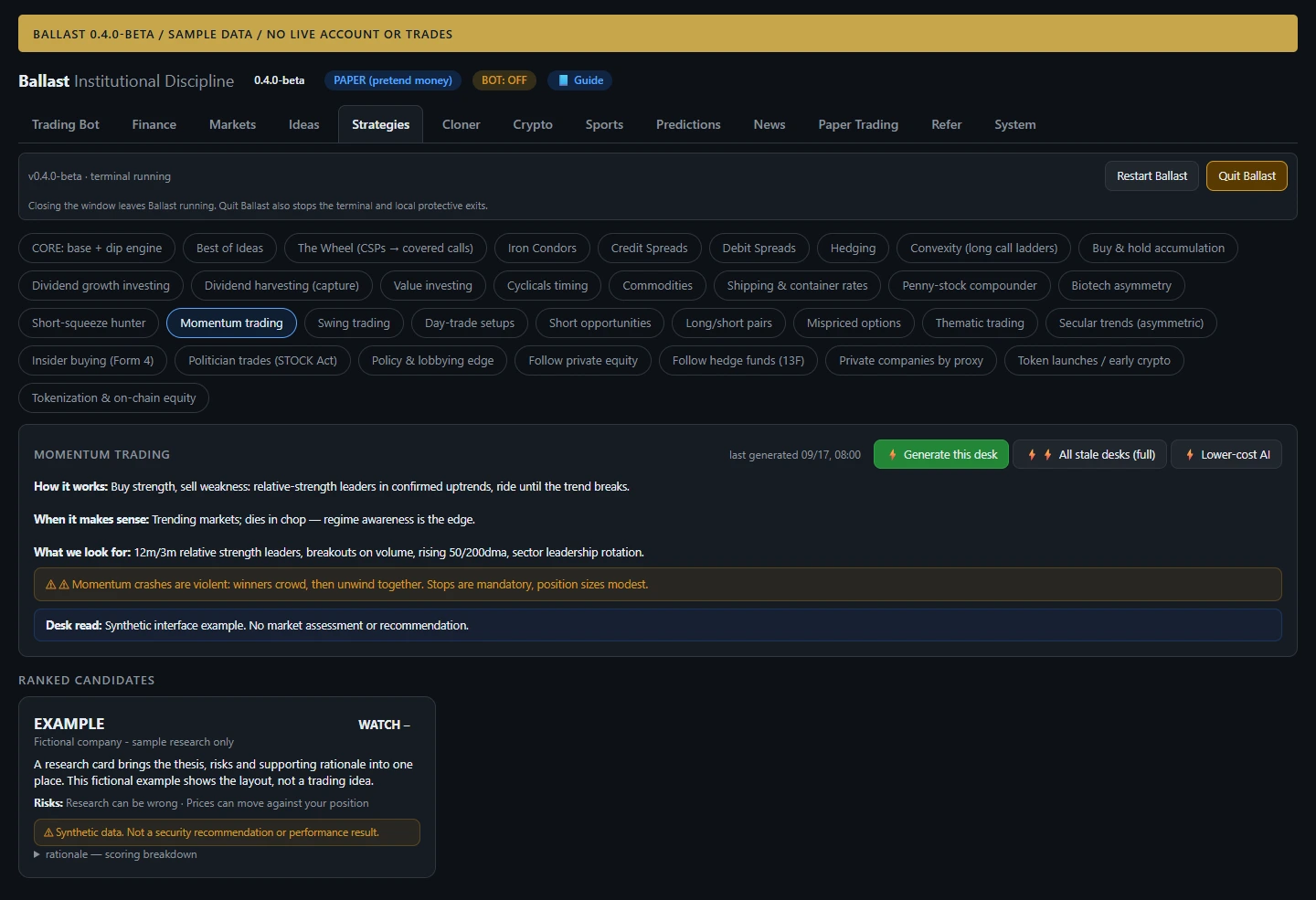
Desk names show research topics, not an execution menu. Options execution is disabled in 0.4.0-beta. Ballast does not automatically run every strategy shown in this screenshot.
How the parts connect
The app and trading records stay on your Windows PC. Broker requests, market data and configured AI features use outside services. Your investment money stays with your broker.

AI features can send selected research, holdings or trading-plan context to the provider. Optional community sharing is off by default. See the privacy details and limits.
Controls worth knowing
Learn these before using real money. Pausing new buying and stopping the whole app have different effects.
| Control or state | What it means |
|---|---|
| Paper mode | Simulated money, in a separate record from live trading. Quotes may also be simulated when broker data is unavailable. |
| Live mode | Uses real money after your explicit confirmation, current Terms acceptance and required account/policy checks. |
| Entry pause / loss breaker | Restricts new buying. Exit checks continue when their required inputs and services are available. |
| Crypto cooldown | After a confirmed stop-loss sale, a per-coin cooldown blocks new entries and adds. The default is 48 hours, with paper and live tracked separately. |
| STOP | Halts automated trading, including automatic exits. It is a total halt. |
| Quit Ballast | Stops the local application and its protective checks. Closing only the browser window can leave it running. |
| Uncertain order | The order needs review against broker evidence. Further orders can be blocked to prevent duplicates. |
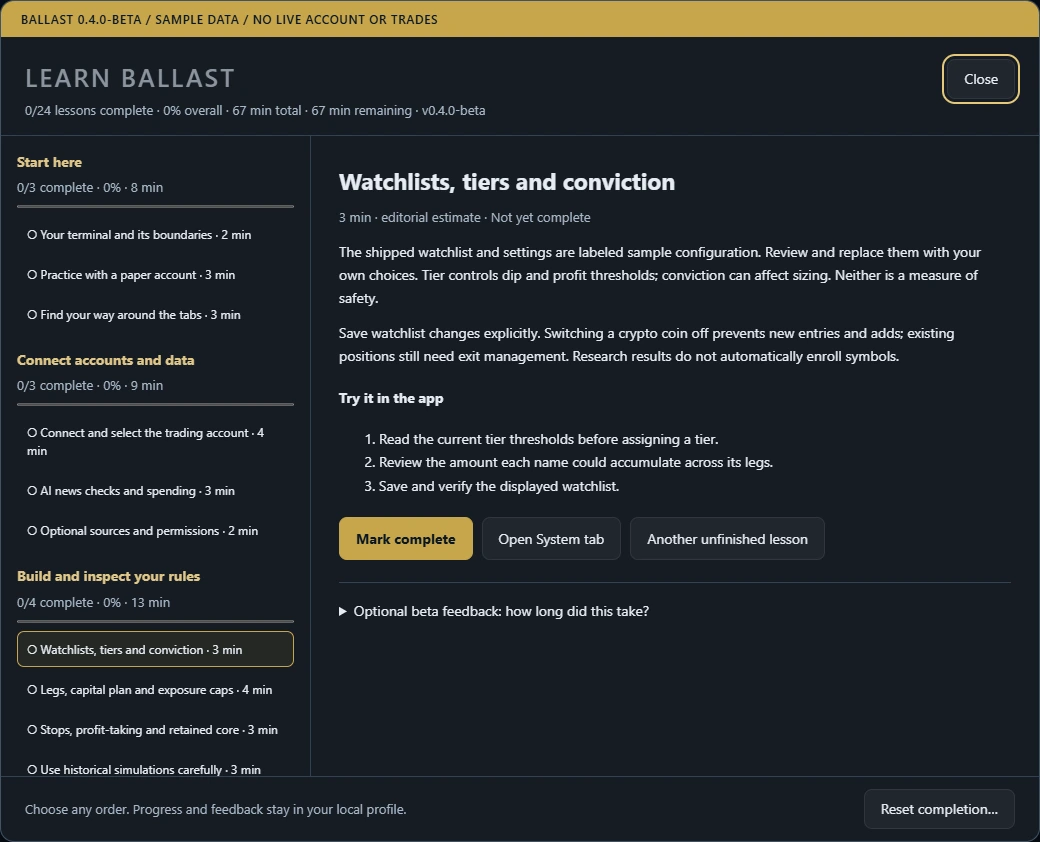
Learn the setup
The in-app guide explains watchlists, trade sizing, controls and updates in selectable lessons. Progress stays in your local profile; completing a lesson does not activate trading.